We’re coming up on the day a self-indulgent son of a bitch, sitting in a gold-glitzed White House he’s blown to shit, will commemorate the 250th anniversary of the United States of America. The joke writes itself, but the punchline is on us. And yet, that hollow spectacle might be the single best argument for what we’re building.
The semiquincentennial was supposed to be a moment of renewal. Two hundred and fifty years after a ragtag collection of colonists decided they’d had enough of a distant king, the Republic would look in the mirror and ask whether the experiment had held. Fireworks over the National Mall, a presidential address from the Rose Garden, schoolchildren reciting the Preamble. Instead, the mirror is cracked and the face staring back is spray-tanned, sneering, and draped in gold leaf that would make a third-tier casino blush.
We know exactly who’s standing there
Let’s not pretend we don’t know who’s standing in that gutted White House. The man who turned the People’s House into a foreclosure auction. The reality-television revenant who gilded the toilets and then complained about the plumbing. A self-indulgent son of a bitch who treats the presidency like a loyalty-card program, redeeming points for ego massages and vendetta fulfillment. He didn’t build a Cabinet; he cast a reunion special. He didn’t govern; he rage-posted through the nuclear codes. And here he is, on the cusp of July 4, 2026, preparing to lecture the nation about liberty while his allies have spent the preceding years torching every institution that liberty requires.
The scene is almost too on the nose. The gold drapes. The Diet Coke button restored. The red hats bussed in to form a human backdrop for a speech that will oscillate between self-congratulation and grievance. And the press corps, those bruised survivors, will cover it like it’s a state funeral for democracy, because in some ways it is. The 250th birthday of the United States will be celebrated by a man who embodies none of its civic virtues and all of its pathologies: the narcissism, the cruelty, the bottomless hunger for attention, the conviction that wealth insulates you from accountability. He’ll smirk. He’ll wave. He’ll say something historically illiterate about the Founding Fathers who, let’s be honest, he thinks are a mortgage company.
Despair is a luxury of the comfortable
The instinct is to despair. But despair is a luxury of the comfortable, and there are too many people whose bodies are on the line-warehouse workers with shattered vertebrae, pregnant people crossing state lines for care, trans kids who just want to survive gym class, tenants facing no-fault evictions so the landlord can hike the rent by forty percent. If we’ve learned anything from the last decade, it’s that the billionaire class has already overthrown democratic institutions and gutted most of America’s labor protections. They did it quietly, then loudly, then with the volume cranked past eleven on a Tuesday afternoon while we were all doomscrolling. The 250th anniversary isn’t a celebration of their victory. It’s a checkpoint. A marker of how far we’ve fallen, and a reminder that monuments don’t reverse power.
Here’s the thing about power: it’s never monolithic. It’s concentrated, sure. It’s backed by money, algorithms, surveillance dragnets, and a political donor class that treats governance as an investment portfolio. But power is also brittle. It relies on our compliance, our exhaustion, our belief that nothing can change. The entire spectacle-the gold, the rallies, the rage-tweets, the Supreme Court decisions that read like ransom notes-is a theater of inevitability. Its message is: You’re alone, you’re powerless, and this is how it’s always going to be.
But 2026 is also the year when millions of Americans have quietly realized that the old tools are broken. The unions that survived the 20th century are hollowed out by decades of hostile legislation and internal bureaucracy. The social media platforms that once promised democratic mobilization have revealed themselves as surveillance machines owned by the very billionaires we need to fight. Every time workers try to organize on Facebook, in an employer’s Slack, or through a Google Sheet, they’re literally inviting the opposition into the room. The Terms of Service are a loaded gun. The metadata is a map of who trusts whom, ready to be subpoenaed, leaked, or sold. You can’t build a counterweight with tools designed to extract profit from your attention. The medium is the message, and the message right now is: we own you.
That’s why we built something else
Not an app to replace Signal. Not a “platform” in the Silicon Valley sense-no engagement loops, no algorithmic amplification, no investor pitch deck full of hockey-stick graphs. We built a protocol. A set of rules for how small groups of people, bound by shared grievances and physical proximity, can govern themselves without bosses, without surveillance, and without permanent leaders. We built a hardened container for the kind of organizing that actually works: face-to-face, trust-first, small enough that everyone knows everyone else’s shift schedule but no one knows anyone’s real name if they don’t want to share it.
The architecture is simple. People form an Orbit-three to twenty-five individuals who are all directly affected by the same issue. They pick their own grievance: scheduling abuse, unsafe conditions, rent gouging, a school board banning books. They rotate every role every ninety days so nobody calcifies into a petty tyrant. They log every decision publicly within the Orbit, so there’s an immutable record that can’t be rewritten when someone gets ambitious. They can’t spend money without two signatures. They can recall any role with a simple majority and forty-eight hours’ notice. And the server? The server is a deaf post. It doesn’t know their names, their faces, their locations beyond a salted hash. It has no analytics. No telemetry. No “sharing with third parties to improve your experience.” It’s a dumb pipe with a good memory and zero loyalty to anyone but the people using it.
We call the larger vision build constellations, not bureaucracies. Orbits connect horizontally. When one Orbit grows past twenty-five, it splits like a cell, not an empire. The two new Orbits each send a mandated delegate to an Assembly, but the delegate carries a written mandate and can be recalled at any moment. No one speaks for anyone else without explicit permission. There are no presidents. No general secretaries. No charismatic figureheads who can be co-opted, arrested, or bought. The network is a star map of autonomous groups that coordinate when they choose to and ignore each other when they don’t. It’s governance without government. It’s unionism without the union bureaucracy. It’s what the Wobblies dreamed of, updated with end-to-end encryption.
No names, no trackers, no leverage
And it works precisely because it refuses to play the game the gold-glitzed White House demands. They want us visible. They want us tracked, profiled, predictable. They want to know who’s angry, who’s connected, who’s likely to act-so they can target, intimidate, fire, evict, deport, or simply drown them in disinformation. Our answer is: no names, no trackers, no leverage. The platform doesn’t know you’re in a union drive. It doesn’t know you’re coordinating a rent strike. It doesn’t know you’re mapping which nurse on which floor is sympathetic to a staffing walkout. It just knows that hash 8f3a2b needs to receive a message from hash 1c90d1, and it delivers it without ever peeking inside.
This isn’t paranoia. It’s a lesson learned from the last twenty years of digital activism. The Tea Party was organized on Facebook. Occupy was coordinated on Twitter. Black Lives Matter chapters found each other through Instagram DMs. And every single one of those movements was mapped, infiltrated, and disrupted by the very platforms that hosted them, because those platforms answer to shareholders and surveillance agencies, not to movements. When you organize on the enemy’s infrastructure, you’re renting space in a building that has a backdoor for your boss, your landlord, and your local police department. We don’t rent. We build our own.
The real anniversary isn’t on the Mall
The 250th anniversary of the United States will be a pageant of hollow symbols. The self-indulgent son of a bitch in the White House will wrap himself in a flag he’s shredded for parts. He’ll invoke the Founders while dismantling the last vestiges of the republic they designed. He’ll talk about freedom while his administration attacks the freedom to organize, the freedom to control your own body, the freedom to read what you want, the freedom to live without the constant threat of state violence. The speech will be a masterclass in projection, a carnival mirror held up to a nation that is exhausted, atomized, and furious.
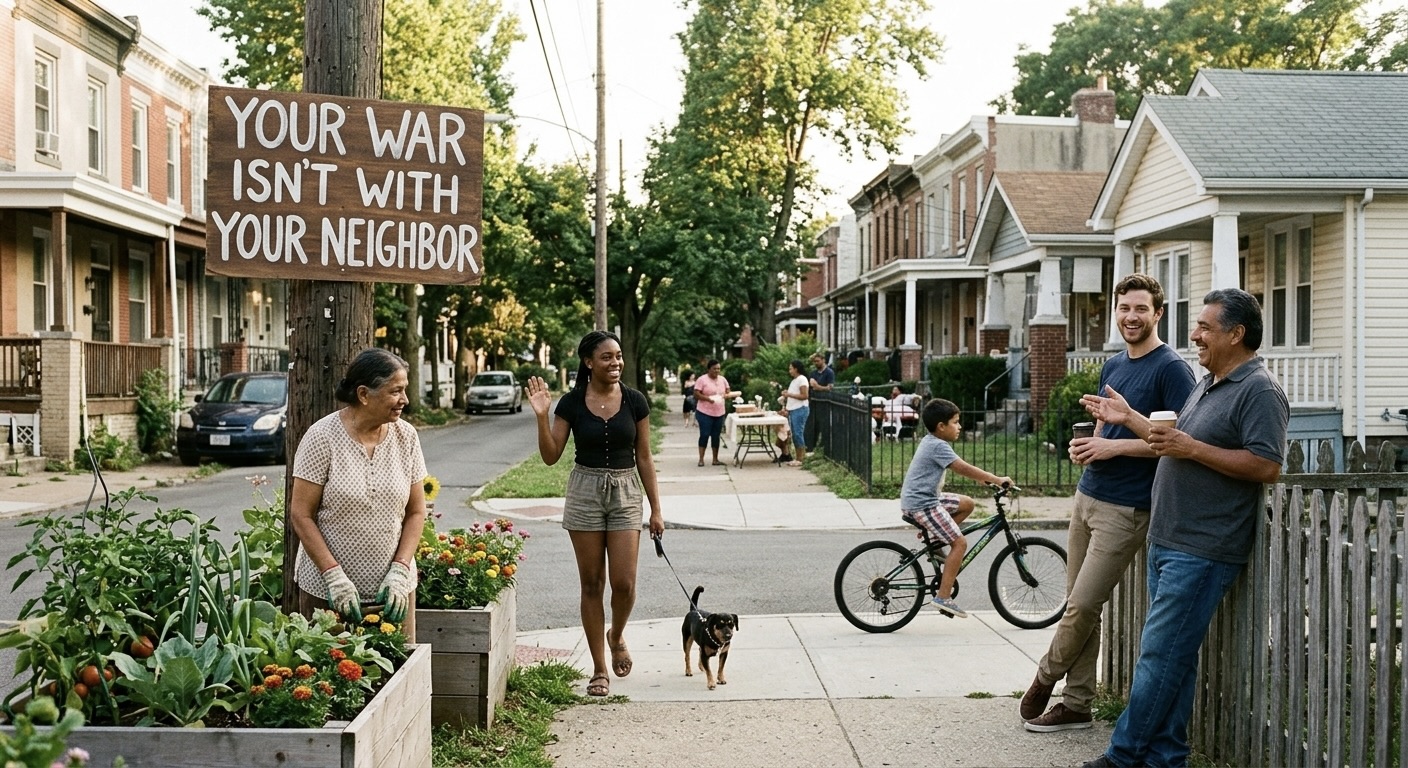
But here’s what he doesn’t understand, what none of them understand: the real 250th anniversary isn’t happening on the National Mall. It’s happening in breakrooms and parking lots, in basement apartments and library meeting rooms, in encrypted group threads where a new kind of civic muscle is being exercised. It’s happening when a home healthcare worker vouches for her neighbor, who vouches for his cousin, who brings three coworkers to an Orbit meeting where they realize they’re all being underpaid by the same agency. It’s happening when tenants in a twelve-unit building discover they each have the same black mold problem and the same unresponsive landlord, and suddenly they’re not twelve isolated complainers — they’re an Orbit with a transparency log, a rotating facilitator, and a plan.
Every Orbit is a small republic. Every transparency log is a declaration of accountability. Every rotated role is a rejection of the strongman logic that has infected our politics from the top down. The protocol doesn’t care if the man in the golden palace hates it. The protocol doesn’t care if the surveillance state wants to read it. The protocol is just rules-rules that anyone can adopt, on any device, with or without the app. Print it out. Memorize it. The governance kernel fits on a single page. That’s the point. The software is a convenience, not a necessity. The movement is the people, not the platform.
Don’t tread on me ended up on a yellow flag, co-opted by every libertarian crank and bumper-sticker patriot. Our version is quieter, more precise, and entirely unmarketable: You can’t tread on what you can’t see.
We’re coming up on the day a self-indulgent son of a bitch tries to own the Fourth of July like he owns everything else-gaudily, temporarily, and at someone else’s expense. Let him have his spectacle. Let him preen for the cameras while the infrastructure of democratic life crumbles around him. We’ll be busy building something he can’t bomb, surveil, buy, or scare. A constellation of Orbits, invisible to power, luminous to each other, waiting for the moment when the spectacle ends and the real work resumes.
The 250th anniversary is a wake. The 251st is when we start taking it all back. Not with a single revolution, but with ten thousand small rooms where nobody knows your name but everybody knows your shift. That’s the constellation. That’s the counterweight. And no amount of gold leaf can cover it up.